
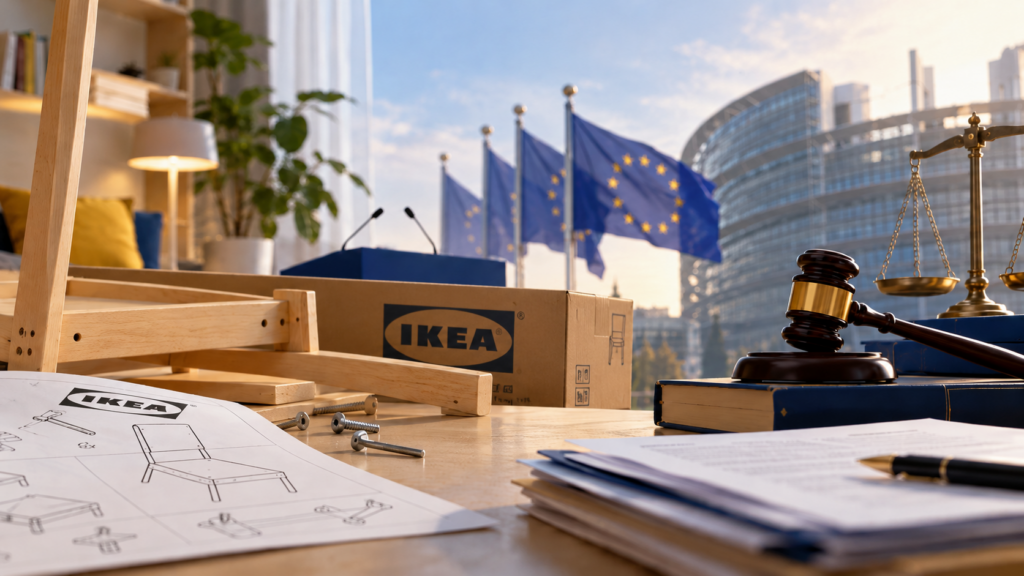
What does IKEA have to do with a political campaign on immigration? And how far can one go in using a well-known brand, invoking freedom of speech?
These questions reached the Court of Justice of the European Union (CJEU), after a Belgian political party used the IKEA name and visual identity to promote its political message, without the consent of the trademark owner.
By its judgment of 8 September 2026 in Case C-298/23, Inter IKEA Systems, the CJEU clarified the limits of freedom of expression when it conflicts with the rights conferred by a trade mark.
How did IKEA get to the center of a political campaign?
It all started in Belgium, where the Vlaams Belang party launched a campaign on immigration and asylum, entitled “IKEA-PLAN”, using, without the company’s consent, the IKEA name, brand graphics and a style inspired by the well-known furniture assembly instructions.
Inter IKEA Systems BV, the owner of the IKEA trademarks, took legal action against the party, and it defended itself by claiming that the materials were political and parodic in nature, protected by freedom of expression.
The Belgian court thus asked the CJEU to clarify: can freedom of expression constitute a ‘due cause’ for the use of a trade mark with a reputation without the consent of the proprietor?
Can freedom of expression justify the use of a trade mark?
The CJEU’s answer was nuanced. The Court confirmed that freedom of expression may, in certain circumstances, constitute a good reason for the use of a well-known trademark. However, the fact that a message is political, satirical or parodic does not automatically make it permissible to use someone else’s trademark.
The rights of the trade mark proprietor and the freedom of expression of the user must be weighed, both protected by the Charter of Fundamental Rights of the European Union (Articles 17 and 11), but neither absolute. The specific circumstances of each case matter: whether the message has a real link with the trade mark or the proprietor’s activity, to what extent the use of the sign was necessary and how the public might perceive the association created.
In other words, freedom of expression does not provide an unlimited right to use the identity of a well-known brand, even if the message aims to contribute to a public debate.
Why was the use of the IKEA brand problematic?
In the case under review, the CJEU noted that the political message on immigration was not directly related to IKEA’s activity or products. The brand had been used to draw attention to the campaign, taking advantage of the company’s notoriety and recognisable visuals, and their repeated use could create an association between IKEA and the political message in the public’s perception.
A company invests time and resources to build its identity and reputation, and unauthorised association with political messages can harm its interests, even if there is no direct competition between the parties. In these circumstances, the CJEU considered that freedom of expression did not seem to justify the use of IKEA signs solely to enhance their reputation.
However, the judgment is not the final solution to the dispute. It remains for the Belgian court to apply the criteria set by the CJEU and decide whether IKEA’s rights have been infringed.
Can a reputable brand be protected outside its market?
The judgment confirms that the protection of a trade mark with a reputation is not limited to situations in which a competitor uses a similar sign. The rights of the proprietor may also be affected by uses that take advantage of or harm the reputation of the trade mark, even outside the field in which the company operates.
There is, however, a distinction: Art. 9 para. (2) letter (c) of Regulation (EU) 2017/1001 concerns the use of a sign in commercial activity, for goods or services, and for other purposes the national rules adopted pursuant to Art. 10 para. (6) of Directive (EU) 2015/2436 may be relevant.
Therefore, not every unauthorized use of a trademark automatically constitutes an infringement of the rights of the owner. The context, purpose of use and applicable legal provisions are analyzed on a case-by-case basis.
What do trademark owners need to remember?
The CJEU ruling does not prohibit the use of well-known brands in satire, criticism or public campaigns, but it does show that freedom of expression cannot be invoked automatically to take advantage of a company’s identity and reputation.
When we talk about trademark infringement, we usually think of counterfeit products, such as jerseys and sports equipment that we discussed in our article “World Cup 2026: A lesson in intellectual property”. The case of IKEA is different, however: we are not talking about products that illegally bear the trademark, but about the use of a brand’s identity in a political campaign – and the CJEU shows that such uses can also raise legal problems, even in the absence of counterfeiting or competition between the parties.
For trademark owners, the case shows that not only the distinctive elements of the brand must be protected, but also the reputation built around it. If you have invested in a brand, make sure it has adequate legal protection and watch for unauthorized uses, the consequences of which can go beyond mere confusion between products.
For advice, assistance or representation in the field of trademark protection, including in situations of unauthorized use or infringement of trademark rights, the TAS team is at your disposal:
📧 E-mail: office@agentiatas.ro
📞 Phone: 0745 160 163