
How do you protect an animation that appears on an app screen? What about the shape of an object that must be looked at from all angles to be understood? Until recently, the answer was quite rigid: through a series of static images, chosen in such a way as to capture the creation as best as possible.
From July 1, 2026, however, the rules have changed. The EUIPO allows European Union designs to be represented not only by images, but also by video files and 3D digital models. Shortly after the entry into force of the new rules, the Office has already published the first records using these formats.
It is one of the most visible changes brought about by the European design reform and, above all, one of the easiest to understand in practice: if the product moves, transforms or needs to be looked at three-dimensionally, the representation submitted to the EUIPO can now more faithfully reproduce these characteristics.
From still photos to dynamic representations
For a chair, a bottle or a simple decorative object, a few well-made images may be enough. The situation becomes more complicated when the design involves movement, visual transitions, or a form that cannot be fully understood from two or three perspectives.
A digital interface, for example, may look different depending on the user’s actions. A symbol can appear, expand, or transform. A product can have moving components or a shape that only reveals itself when rotated.
In such cases, still images risk fragmenting what, in reality, is a unitary visual experience. Video and 3D representation solve precisely this problem.
Digital models can be submitted in formats such as OBJ or STL, and animated representations can be transmitted via MP4 files. Thus, the applicant is no longer obliged to reduce a dynamic creation to a succession of catches.
The first weeks showed that there was already a real need
The new formats did not remain just a theoretical possibility. In the first half of July 2026, EUIPO received 37 submissions using video files and 20 submissions based on 3D representations.
During the same period, 4,329 designs were submitted through still views, which shows that classic images will continue to be used in most cases. However, the 57 submissions through new formats, registered in just two weeks, confirm that there was already a category of creations for which the old system was too limited.
The change does not mean that all designs should now be submitted via video or 3D. It just means that the applicant has a more suitable tool at their disposal when the usual images do not render the product clearly enough.
For whom can this novelty be relevant?
The first obvious beneficiaries are developers of applications, platforms and software products. Graphical interfaces, animations, dynamic icons, and transitions between screens can be much easier to present in a video file than through separate captures.
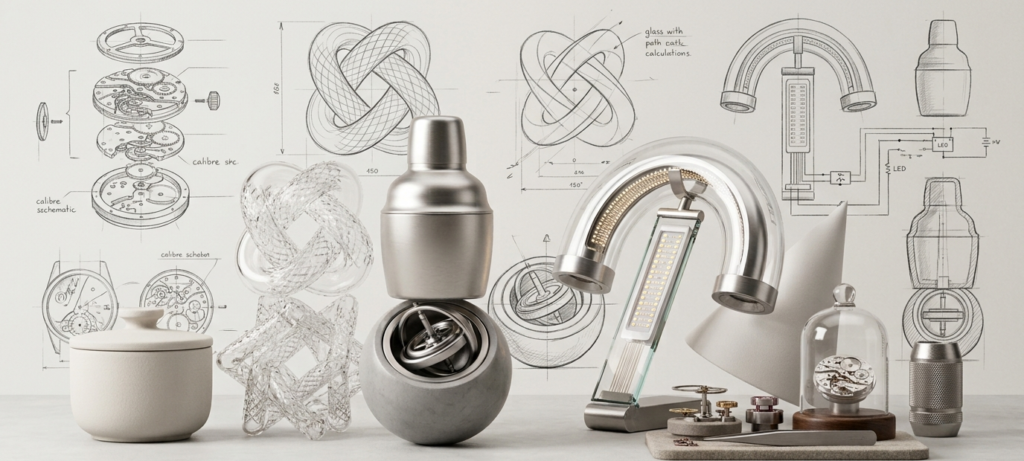
3D models can be particularly useful for product designers, manufacturers of furniture, electronic devices, lighting fixtures, packaging or technical components. In these areas, the shape of the object and the relationship between its various surfaces can be difficult to fully render through two-dimensional images.
The novelty is also relevant for the video game industry, virtual product creators, design studios, branding agencies and companies that use 3D printing.
A digital file is not just a presentation tool. In the case of 3D printing, it can even be the starting point for the manufacture of the product. That is why the reform clarifies that the creation, downloading or distribution of files that allow the reproduction of a protected design may constitute an infringement of the rights of the owner.
One type of representation for each design
Although the new rules allow for multiple formats, they cannot be freely combined within the same representation.
Only one type of representation must be used for each design: static, dynamic or animated. It is not possible, for example, to submit static photos and a video for the same design at the same time.
In the case of a static representation, up to ten views can be submitted. For a dynamic or animated representation, only one file is allowed for each design.
Regardless of the format, all views must be about the same product or part of a product. The representation must be coherent and not leave the impression that several different creations are included in the same application.
The design can be represented in black and white or color. However, the choice must be made carefully, as the color can also influence the extent of the protection requested.
More freedom, but not less attention
The new formats provide flexibility, but they do not eliminate the essential rules of design representation.
For each design, only one type of representation must be chosen: static, dynamic or animated. You can’t combine a set of photos with a video or a 3D model in the same submission.
In the case of still images, up to ten views can be submitted. For an animated or dynamic representation, only one file is submitted for each design.
Design reform is beginning to be seen in practice
The acceptance of video files and 3D models is just one of the changes introduced by the European design reform. The new rules updated definitions, simplified taxes, and clarified the protection of digital creations, 3D printing files, and counterfeit products in transit.
We presented the main changes in a previous article, which you can check out here.
However, the first records published by the EUIPO show something more concrete: the European system is finally starting to speak the same language as the products it is supposed to protect. Sometimes this language is a photo. Other times, it’s a 3D object or image that comes to life on the screen.
If you want to find out whether the product, app interface, animation, packaging or any other visual element created by you can benefit from protection by registering a design with the EUIPO, the TAS Agency team can provide you with advice and assistance throughout the entire procedure.
📧 Email: office@agentiatas.ro
📞 Phone: 0745 160 163