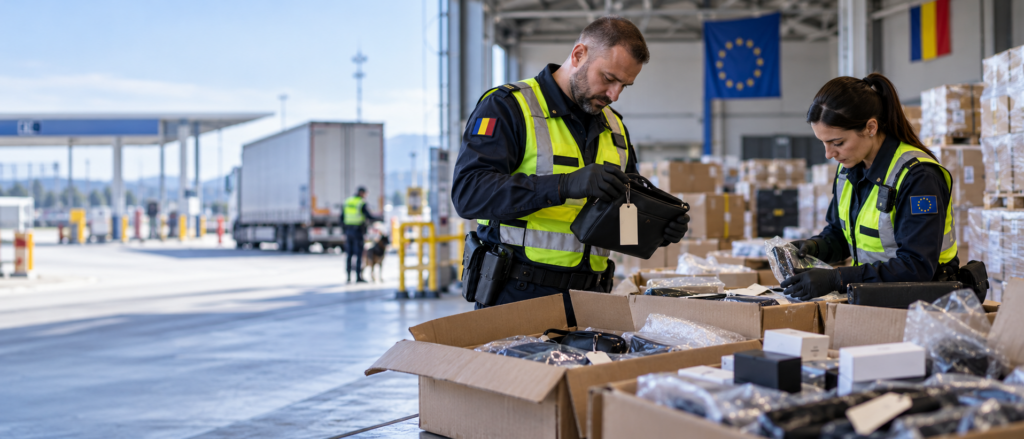
More than 196 million counterfeit products, worth an estimated €6.3 billion, were detained in the European Union in 2025. It is the highest number ever reported by European authorities, according to the joint report published on 22 October 2026 by the EUIPO and the European Commission’s Directorate-General for Taxation and Customs Union (DG TAXUD).
For Romanian entrepreneurs, the report contains a figure that deserves attention: at the EU’s external border, Romania detained 43% of all counterfeit items, ahead of Bulgaria and Italy.
At first glance, it seems like news about customs and statistics. In reality, it shows very clearly why a registered trademark is not just a certificate, but a concrete tool for defending the business.
What the report shows?
The number of items detained in 2025 is 67% higher than in 2024 and 29% above the previous record, from 2023. The figures cover both the Union’s external border and internal market controls.
The most frequently retained products were recorded CDs and DVDs (music, movies, retro games, software), with almost 30% of the total. Almost one in five items was a toy. Also on the list are consoles and games, clothing, cigarettes and electronic cigarettes.
An interesting detail: a lot of labels, badges and stickers were intercepted. According to the EUIPO, they can be used to “complete” counterfeit products right within the EU. In other words, the goods can enter “anonymously” and someone else’s trademark is subsequently applied.
In the EU’s internal market, trademarks were the most frequently infringed rights (57% of articles retained), followed by copyright (43%) and designs (7%). The percentages together exceed 100%, as a product can infringe several rights simultaneously. Also in the domestic market, Italy made more than 70% of retainers.
Why it matters for companies in Romania?
Romania manages an important part of the Union’s external border, both on land and through the port of Constanta. The fact that 43% of the items detained at the EU’s external border were registered here highlights the important role of the Romanian customs authorities in combating counterfeiting. However, the percentage refers to the number of items detained, not to the number of interventions or to all counterfeit products entering the Union.
For trademark owners, this data shows how relevant cooperation with customs authorities can be. Customs can act much more effectively when it knows what rights it needs to protect and what the original product looks like.
And that’s where the trademark comes in.
Trademark: an essential tool for customs protection.
Customs authorities can intervene against goods suspected of infringing intellectual property rights, including on their own initiative. However, by submitting a request for customs intervention, rights holders can facilitate the identification of counterfeit products and the intervention of the authorities.
The application for customs intervention is governed by Regulation (EU) no. 608/2013. By it, the proprietor of a trade mark, design, copyright or geographical indication requires customs to detain goods suspected of infringing his rights.
Some practical aspects:
- The submission and processing of the application is free of charge. The application is valid for up to one year and can be extended. However, the free application does not cover any costs of storage or destruction of the retained goods, which may be borne by the rightholder.
- The owner of an EU trade mark can file an application at EU level, valid in several Member States, not only in Romania.
- The application must help customs officers to recognize the original product: packaging, labels, distribution channels, differences from children.
- Goods may be destroyed without a lawsuit for infringement, but only under certain conditions. The right holder must confirm in writing, within the legal time limit, that in his or her opinion an infringement has occurred and that he agrees to the destruction of the goods.
For trade marks, the basic condition remains the same: the trade mark must be registered. A name that has been used for years but not registered cannot form the basis of an application for trade mark intervention and does not automatically confer the specific protection of a registered trade mark.
What the owner of a trademark can do concretely?
Protection against counterfeiting begins long before the goods reach the border. In practice, we recommend four steps:
- Register your trademark where you sell your products. For the Romanian market, at OSIM. For several states in the Union, an EU trade mark with the EUIPO may be the most effective solution.
- You also protect the appearance of the product. If the shape, packaging or decorative elements are novel and individual, registration as a design completes the protection of the trademark.
- Submit your application for customs intervention. Applications are submitted electronically, via the Intellectual Property Rights Enforcement Portal (IPEP), managed by the EUIPO. The portal also facilitates the exchange of information between rightholders and competent authorities.
- Monitor the trademark. A supervisory service notifies you when someone files a similar trademark so that you can file an opposition in time.
Cooperation between holders and authorities will also be the theme of the next edition of the IPEP Forum, organised by the EUIPO on 24–25 November 2026.
A problem that does not only concern the big brands
I recently wrote about the seizure of counterfeit equipment before the 2026 World Cup. The EUIPO report shows that the number of products suspected of counterfeiting and detained by the authorities has increased considerably. The copied toys, clothing and accessories not only bear the logos of large companies, but also those of small and medium-sized manufacturers who have managed to become well-known.
The more successful a product is, the more attractive it becomes to those who copy it. A timely trademark is the difference between being able to stop such merchandise and seeing it sold under your name.
Counterfeiting does not stop at logos and names. Packaging, the shape of products or the decorative motifs printed on them are just as often copied. That is why we also recommend protecting them by registering them as a design with the EUIPO, which offers protection, through a single application, in all EU Member States.
If you want to register your trademark, protect the packaging, shape or decorative motifs of your products, or check whether the existing protection is sufficient, the CAS Agency team can provide you with advice and assistance throughout the entire procedure.
📧 Email: office@agentiatas.ro
📞 Phone: 0745 160 163